
Monday, April 7, 2014


Sunday, April 6, 2014


Friday, March 28, 2014
ISRAEL’S DEFENSE CHIEF WARNS U.S. IS TOO “WEAK” TO RELY ON FOR SUPPORT AGAINST IRAN

Israel’s defense minister has accused the United States of projecting weakness internationally and said Israel could not rely on its main ally to take the lead in confronting Iran over its nuclear program.
Moshe Yaalon, whose remarks were reported in the Haaretz daily on Tuesday, caused friction with the United States only two months ago when he described Secretary of State John Kerry’s quest for Israeli-Palestinian peace as messianic and obsessive.
His latest comments, confirmed by an Israeli official who was present at lecture Yaalon delivered at Tel Aviv University on Monday, displayed deep disappointment with U.S. President Barack Obama’s handling of burning world issues.
“We had thought it would be the United States that would lead the campaign against Iran,” said Yaalon, who pointed to the Ukraine crisis as an example of Washington “showing weakness”.
It was unclear from Yaalon’s reported remarks where he believed the United States, which on Monday imposed sanctions on two top aides to President Vladimir Putin and nine other people linked to Russia’s Crimean incursion, had gone wrong on Ukraine.
Iran and six world powers will try to make headway on the nuclear dispute in talks that started in Vienna on Tuesday, with Western officials hoping the challenge will not be made even more difficult by the Ukraine crisis.
Yaalon said that although “people know Iran cheats”, the United States and other nations chose to negotiate with Tehran on restricting activities they fear are aimed at developing atomic arms.
“Therefore, on this matter, we have to behave as though we have nobody to look out for us but ourselves,” Yaalon said, echoing Prime Minister Benjamin Netanyahu’s veiled threats of unilateral military action against Iran if diplomacy fails.
“Unfortunately, when it comes to negotiating at a Persian bazaar, the Iranians are better,” said Yaalon, a former armed forces chief and a hawkish member of Netanyahu’s right-wing Likud party.
In the Middle East, Yaalon said, he had heard “voices of disappointment” over a lack of U.S. support for Sunni Muslim rebels in the three-year-old conflict in Syria.
And on a recent visit in Asia, he added, he found “disappointment about China getting stronger and the U.S. getting weaker”.
Netanyahu, whose country is widely believed to be the Middle East’s only nuclear-armed nation, has denounced as a “historic mistake” an interim deal reached with Iran in November on curbing sensitive nuclear activities in return for limited sanctions relief.
He has demanded that any final accord dismantle Tehran’s uranium enrichment centrifuges, a position at odds with Obama’s suggestion that Iran, which says its nuclear program is peaceful, could be allowed to enrich on a limited basis for civilian purposes.
“Comfortable Westerners prefer to put off confrontation, if possible to next year or the next leadership term. But in the end, it will blow up,” Yaalon said.
Source
http://banoosh.com/blog/2014/03/18/israels-defense-chief-warns-u-s-weak-rely-support-iran/

TONY ABBOTT FACES INTERNAL BACKLASH OVER RACIAL DISCRIMINATION LAW CHANGE
Liberal party’s first Indigenous lower house MP warns that he might cross the floor to vote against the legislation
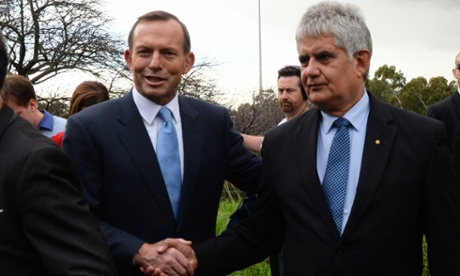
Tony Abbott faces an internal backlash over his plans to amend the
Racial Discrimination Act, with the Liberal party’s first Indigenous
lower house member, Ken Wyatt, warning that he might cross the floor to
vote against the legislation.
Another Coalition MP, Ewen Jones, told his colleagues at a joint Liberal and National party meeting on Tuesday that the government must be careful about the optics of the proposal and ensure it did not appear too ideological.
Abbott promised before the election to amend the Racial Discrimination Act in the interests of upholding free speech.
Unhappy with a 2011 federal court ruling about articles by the conservative commentator Andrew Bolt, the Coalition vowed to repeal section 18C in its current form. The section makes it unlawful to “offend, insult, humiliate or intimidate” a person or group because of their “race, colour or national or ethnic origin”.
The internal concerns came as community groups warned the government against pursuing “morally repugnant” changes to racial discrimination laws, arguing Australia’s national interests were being sacrificed to score points in the “culture wars”.
In a blistering joint statement issued on Tuesday, representatives of the Indigenous, Greek, Jewish, Chinese, Arab, Armenian and Korean communities vowed to step up their campaign against amendments that would “license the public humiliation of people because of their race”.
It is understood Wyatt, Jones and other Coalition MPs David Coleman, Craig Laundy, Alex Hawke, George Christensen and Ian Macdonald offered their views on the issue at the private meeting of Liberal and National members on Tuesday.
Guardian Australia understands that Wyatt made a “very forceful” contribution which left open the option of crossing the floor to vote against the possible changes. It is understood he said he had lost friends and people close to him over racism.
Several MPs called on the government to make sure it handled the issue sensitively and noted that ethnic groups were worried about changes.
But one MP countered: “Freedom of speech is a God-given right; if we don’t allow things we don’t want to hear then we don’t believe in freedom.”
Jones told Guardian Australia: “As a middle-aged white man I have never experienced any form of discrimination. From my perspective I could be high about this and say it shouldn’t matter, but I’ve never experienced that and I think we should be very aware of listening to opinions of people who have experienced it.”
Abbott sought to emphasise the common ground between his colleagues.
“Everyone in this room believes in freedom of speech, everyone in the room is against racism, everyone in this room thinks Andrew Bolt should not have been prosecuted,” the prime minister told Coalition MPs.
Abbott observed that there had been a very exhaustive process of consultation and the party needed to reconcile the three points of views. He went on to praise long serving member Philip Ruddock for transforming the relationship between the Coalition and areas of the Australian community, referring to ethnic groups.
“We are the right party to represent a diverse country,” Abbott said.
The government is yet to release legislation showing the extent of proposed changes to the Racial Discrimination Act. Labor and the Greens, which retain the power to block legislation in the Senate until July, have argued against the need for the change.
A federal court judge in 2011 found that Bolt breached part 18C of the Racial Discrimination Act by publishing newspaper articles that questioned the motivations of fair-skinned people who identified as Aboriginal.
Concerned about the federal court ruling, the Coalition promised to repeal section 18C of the Racial Discrimination Act in its current form.
http://www.theguardian.com/world/2014/mar/18/tony-abbott-faces-internal-backlash-over-racial-discrimination-law-change

Another Coalition MP, Ewen Jones, told his colleagues at a joint Liberal and National party meeting on Tuesday that the government must be careful about the optics of the proposal and ensure it did not appear too ideological.
Abbott promised before the election to amend the Racial Discrimination Act in the interests of upholding free speech.
Unhappy with a 2011 federal court ruling about articles by the conservative commentator Andrew Bolt, the Coalition vowed to repeal section 18C in its current form. The section makes it unlawful to “offend, insult, humiliate or intimidate” a person or group because of their “race, colour or national or ethnic origin”.
The internal concerns came as community groups warned the government against pursuing “morally repugnant” changes to racial discrimination laws, arguing Australia’s national interests were being sacrificed to score points in the “culture wars”.
In a blistering joint statement issued on Tuesday, representatives of the Indigenous, Greek, Jewish, Chinese, Arab, Armenian and Korean communities vowed to step up their campaign against amendments that would “license the public humiliation of people because of their race”.
It is understood Wyatt, Jones and other Coalition MPs David Coleman, Craig Laundy, Alex Hawke, George Christensen and Ian Macdonald offered their views on the issue at the private meeting of Liberal and National members on Tuesday.
Guardian Australia understands that Wyatt made a “very forceful” contribution which left open the option of crossing the floor to vote against the possible changes. It is understood he said he had lost friends and people close to him over racism.
Several MPs called on the government to make sure it handled the issue sensitively and noted that ethnic groups were worried about changes.
But one MP countered: “Freedom of speech is a God-given right; if we don’t allow things we don’t want to hear then we don’t believe in freedom.”
Jones told Guardian Australia: “As a middle-aged white man I have never experienced any form of discrimination. From my perspective I could be high about this and say it shouldn’t matter, but I’ve never experienced that and I think we should be very aware of listening to opinions of people who have experienced it.”
Abbott sought to emphasise the common ground between his colleagues.
“Everyone in this room believes in freedom of speech, everyone in the room is against racism, everyone in this room thinks Andrew Bolt should not have been prosecuted,” the prime minister told Coalition MPs.
Abbott observed that there had been a very exhaustive process of consultation and the party needed to reconcile the three points of views. He went on to praise long serving member Philip Ruddock for transforming the relationship between the Coalition and areas of the Australian community, referring to ethnic groups.
“We are the right party to represent a diverse country,” Abbott said.
The government is yet to release legislation showing the extent of proposed changes to the Racial Discrimination Act. Labor and the Greens, which retain the power to block legislation in the Senate until July, have argued against the need for the change.
A federal court judge in 2011 found that Bolt breached part 18C of the Racial Discrimination Act by publishing newspaper articles that questioned the motivations of fair-skinned people who identified as Aboriginal.
Concerned about the federal court ruling, the Coalition promised to repeal section 18C of the Racial Discrimination Act in its current form.
http://www.theguardian.com/world/2014/mar/18/tony-abbott-faces-internal-backlash-over-racial-discrimination-law-change
POLICE HOLD ARMED STANDOFF AGAINST MAN WITH GUN TATTOO
The homeowner was awoken to the sound of police loudspeakers and the sight of armed cops surrounding his house.

Maine State Police Trooper Scott Duff trains his rifle on Michael Smith’s home; a man accused of being a gun owner. (Source: David Leaming / Morning Sentinel)
Michael Smith works the night shift and sleeps during the day. On the morning of March 18th, he was disturbed when he heard a loud racket in his front yard. It was a tree removal service backing into his driveway preparing to chopping branches around power lines.
Mr. Smith groggily stepped outside in his pajama pants to tell the tree trimmers to come back another time. They told him it was not a problem, reported the Morning Sentinel.
The only problem was that one of the workers saw Smith’s stomach tattoo and perceived it to be a real gun. Even though no threats had been made, the worker called police to report a “man with a gun.”
It should be noted that it is not a crime openly wear a handgun in the waistband in Maine. At home or in public; shirtless or clothed; quiet or shouting; open carry is a recognized right in that state and no justification for police intervention.
Despite this, Maine State Troopers picked up their rifles and produced a life-threatening standoff in front of Mr. Smith’s house.

Rude Awakening: Michael Smith is the target of a police standoff because of his tattoo. (Source: David Leaming / Morning Sentinel)
This time it was the sound of police loudspeakers. State Troopers and Sheriff’s deputies were outside aiming guns at his house and making demands.
Smith got out of bed again and surrendered to the police in his front yard, saying, “I got plans today. I didn’t want to get shot.”
The whole thing had been an embarrassing overreaction. Still, police stood by their dramatic response.
“Obviously it was a misunderstanding and he didn’t have a weapon, but we had to respond to the initial report as if he did,” Maine State Police Trooper Scott Duff said to the Morning Sentinel. “We take all precautions when we don’t have the details.”
“Man with a gun” calls — or MWAG — are infamously prone to dramatic police overreactions. Innocent citizens all over the country have been subjected to being harassed, handcuffed, proned out, had guns pointed at them, and otherwise bullied and threatened while doing absolutely nothing illegal or wrong.
If armed police officers were treated in such a way every time they were spotted with a pistol on their belt, they might understand the unfairness of this type of response.
stories that remain conspicuously ignored by the national mainstream media, and your generous support is essential
to effectively distributing this message. Many victims of government-sanctioned violence offer their gratitude.
http://www.policestateusa.com/2014/gun-tattoo-leads-to-police-standoff/

HOW DID THE PRO-PAEDOPHILE GROUP PIE EXIST OPENLY FOR 10 YEARS?
27 February 2014
 Former KGB spy and PIE member Geoffrey Prime (left) and PIE Chairman Tom O'Carroll
A gay rights conference backs a motion in favour of
paedophilia. The story is written up by a national newspaper as
"Child-lovers win fight for role in Gay Lib".
It sounds like a nightmarish plotline from dystopian fiction. But this happened in the UK. The conference took place in Sheffield and the newspaper was the Guardian. The year was 1975.
It's part of the story of how paedophiles tried to go mainstream in the 1970s. The group behind the attempt - the Paedophile Information Exchange - is back in the news because of a series of stories run by the Daily Mail about Labour deputy leader Harriet Harman.
PIE was formed in 1974. It campaigned for "children's sexuality". It wanted the government to axe or lower the age of consent. It offered support to adults "in legal difficulties concerning sexual acts with consenting 'under age' partners". The real aim was to normalise sex with children.
Journalist Christian Wolmar remembers their tactics. "They didn't emphasise that this was 50-year-old men wanting to have sex with five-year-olds. They presented it as the sexual liberation of children, that children should have the right to sex," he says.
It's an ideology that seems chilling now. But PIE managed to
gain support from some professional bodies and progressive groups. It
received invitations from student unions, won sympathetic media coverage
and found academics willing to push its message.
It's wrong to say that PIE was tolerated during the 1970s, says Times columnist Matthew Parris. "I remember a lot of indignation about it [PIE]. It was considered outrageous."
The group's visits to universities were often opposed. In 1977 PIE's chairman Tom O'Carroll was ejected from a conference on "love and attraction" at University College, Swansea after lecturers "threatened not to deliver their papers if Mr O'Carroll stayed", the Times reported. The May 1978 issue of Magpie, PIE's in-house newspaper, records how O'Carroll had been invited to address students at Liverpool and Oxford University but that the visits were cancelled after local opposition.
 Protestors and police outside Conway Hall, London, where PIE was holding its first open meeting in 1977
One of PIE's key tactics was to try to conflate its cause with
gay rights. On at least two occasions the Campaign for Homosexual
Equality conference passed motions in PIE's favour.
Protestors and police outside Conway Hall, London, where PIE was holding its first open meeting in 1977
One of PIE's key tactics was to try to conflate its cause with
gay rights. On at least two occasions the Campaign for Homosexual
Equality conference passed motions in PIE's favour.
Most gay people were horrified by any conflation of homosexuality and a sexual interest in children, says Parris. But PIE used the idea of sexual liberation to win over more radical elements. "If there was anything with the word 'liberation' in the name you were automatically in favour of it if you were young and cool in the 1970s. It seemed like PIE had slipped through the net."
Some have suggested that nature of debate then was different. "In this free-for-all anything and everything was open for discussion," said Canon Angela Tilby on Radio 4's Thought for the Day. "There were those who claimed that sexual relationships between adults and children could be harmless." Homosexuality had only been decriminalised in 1967. There was still prejudice and inequality. The age of consent was 16 for heterosexuals but 21 for homosexual men.
Wolmar's colleagues pressed the man from PIE on the age of
consent. Wolmar says that the man said there should be no age of
consent. Shocked at the idea of a group advocating sex with babies, he
and his colleagues unanimously decided to "boot them out".
It was easy to join PIE. According to a Times legal report on a blackmail case from February 1977, there was no need for subterfuge, just an application and a cheque for £4. In the report, the prosecutor in the case stated: "He said on the form that he was a paedophile, male, married, 29 years old and attracted to girls between the ages of seven and 13 years." The judge proclaimed himself "horrified" at the existence of PIE.
Unsettlingly for a modern audience, the PIE member received anonymity (as is typical in blackmail cases) and there is no mention of any prosecution of him. Meanwhile, the blackmailer was jailed for three years.
The brazenness could be shocking. Keith Hose, one of PIE's leaders during the 1970s, was quoted by a newspaper saying: "I am a paedophile. I am attracted to boys from about 10, 11, and 12 years of age. I may have had sexual relations with children, but it would be unwise to say."
When Polly Toynbee interviewed O'Carroll and Hose in the Guardian in September 1977 she heard men incredulous at the lack of support from the press. They seemed genuinely aggrieved at what they called a "Fleet Street conspiracy". One of them told her: "We would expect the Guardian, a decent liberal newspaper to support us."
 Labour politicians Harriet Harman and Patricia Hewitt have come under fire for the NCCL's links to PIE
In a Guardian piece from 1975 it's clear "paedophile" was still not a widely used term and the opening line explains it - "one who is sexually attracted to children". In the piece, Hose is treated as a reliable source throughout.
There were divisions within progressive circles. In 1977 the Campaign for Homosexual Equality passed by a large majority a resolution condemning "the harassment of the Paedophile Information Exchange by the press".
When Peter Hain, then president of the Young Liberals, described paedophilia as "a wholly undesirable abnormality", a fellow activist hit back. "It is sad that Peter has joined the hang 'em and flog 'em brigade. His views are not the views of most Young Liberals."
And when a columnist supported Hain in the Guardian he was inundated with mail from people - many willing to give their name - who defended sex with children.
Reading the newspapers of the time there is a palpable anxiety that PIE was succeeding.
Toynbee talked of her "disgust, aversion and anger" at the
group but added that she had "a sinking feeling that in another five
years or so, their aims would eventually be incorporated into the
general liberal credo, and we would all find them acceptable".
There was a battle raging over free speech.
Some, such as philosopher Roger Scruton, felt that freedom of speech had to be sacrificed when it came to groups like PIE. In a Times piece in September 1983 he wrote: "Paedophiles must be prevented from 'coming out'. Every attempt to display their vice as a legitimate 'alternative' to conventional morality must be, not refuted, but silenced."
A Times letter writer, Peter Cadogan, took a different line, defending PIE from the National Front despite loathing them. "Yet again, they assaulted me with stink bombs and sundry soft fruit when I was defending the freedom of speech of another group I abhorred, viz, the Paedophile Information Exchange." He continues that the way to cover "nasty people with nasty ideas" is to "give them all the rope they want and then hang them with it every time they practice what they preach".
But during the 1980s, PIE came a cropper. Its notoriety grew in 1982 with the trial of Geoffrey Prime, who was both a KGB spy and a member of PIE. He was jailed for 32 years for passing on secrets from his job at GCHQ to the Soviet Union, and for a series of sex attacks on young girls.
A short article from the Daily Mail in June 1983 records how a scoutmaster in Castle Bromwich, Birmingham, resigned after being exposed as a member of PIE.
 In August 1983 a Scottish headmaster, Charles Oxley, handed
over a dossier about PIE to Scotland Yard after infiltrating the group, the Glasgow Herald wrote. He said the group had about 1,000 members.
In August 1983 a Scottish headmaster, Charles Oxley, handed
over a dossier about PIE to Scotland Yard after infiltrating the group, the Glasgow Herald wrote. He said the group had about 1,000 members.
But the NCCL continued to defend having PIE as a member. As late as September 1983, an NCCL officer was quoted in the Daily Mail saying the group was campaigning to lower the age of consent to 14. "An offiliate [sic] group like the Paedophile Information Exchange would agree with our policy. That does not mean it's a mutual thing and we have to agree with theirs."
The authorities debated ways of shutting PIE down. O'Carroll was sentenced to two years in jail for "conspiracy to corrupt public morals" and PIE was disbanded in 1984.
It's hard now to believe the group existed for more than a decade. "Even then the word paedophile was pretty taboo," says Wolmar. "I do find it slightly astounding that they were able to use that name."
http://www.bbc.com/news/magazine-26352378

Former KGB spy and PIE member Geoffrey Prime (left) and PIE Chairman Tom O'Carroll
The
Paedophile Information Exchange was affiliated to the National Council
for Civil Liberties - now Liberty - in the late 1970s and early 1980s.
But how did pro-paedophile campaigners operate so openly?
It sounds like a nightmarish plotline from dystopian fiction. But this happened in the UK. The conference took place in Sheffield and the newspaper was the Guardian. The year was 1975.
It's part of the story of how paedophiles tried to go mainstream in the 1970s. The group behind the attempt - the Paedophile Information Exchange - is back in the news because of a series of stories run by the Daily Mail about Labour deputy leader Harriet Harman.
“Start Quote
Matthew Parris, columnistIf there was anything with the word 'liberation' in the name you were automatically in favour of it if you were young and cool in the 1970s. It seemed like PIE had slipped through the net”
The Daily Mail has revisited the
story of PIE to ask how much Harman and her husband the MP Jack Dromey
knew about the group during their time working at the National Council
for Civil Liberties, now Liberty, in the late 1970s. PIE was affiliated
to the NCCL from the late 1970s to early 1980s.
Many of the revelations are not in fact new. The story's
return to the front pages demonstrates the shock people feel about how a
group with "paedophile" in its name could operate so openly for so
long.PIE was formed in 1974. It campaigned for "children's sexuality". It wanted the government to axe or lower the age of consent. It offered support to adults "in legal difficulties concerning sexual acts with consenting 'under age' partners". The real aim was to normalise sex with children.
Journalist Christian Wolmar remembers their tactics. "They didn't emphasise that this was 50-year-old men wanting to have sex with five-year-olds. They presented it as the sexual liberation of children, that children should have the right to sex," he says.
John Tusa interviews two members of the Paedophile Information Exchange on Newsnight in 1983
It's wrong to say that PIE was tolerated during the 1970s, says Times columnist Matthew Parris. "I remember a lot of indignation about it [PIE]. It was considered outrageous."
The group's visits to universities were often opposed. In 1977 PIE's chairman Tom O'Carroll was ejected from a conference on "love and attraction" at University College, Swansea after lecturers "threatened not to deliver their papers if Mr O'Carroll stayed", the Times reported. The May 1978 issue of Magpie, PIE's in-house newspaper, records how O'Carroll had been invited to address students at Liverpool and Oxford University but that the visits were cancelled after local opposition.
Protestors and police outside Conway Hall, London, where PIE was holding its first open meeting in 1977Most gay people were horrified by any conflation of homosexuality and a sexual interest in children, says Parris. But PIE used the idea of sexual liberation to win over more radical elements. "If there was anything with the word 'liberation' in the name you were automatically in favour of it if you were young and cool in the 1970s. It seemed like PIE had slipped through the net."
Some have suggested that nature of debate then was different. "In this free-for-all anything and everything was open for discussion," said Canon Angela Tilby on Radio 4's Thought for the Day. "There were those who claimed that sexual relationships between adults and children could be harmless." Homosexuality had only been decriminalised in 1967. There was still prejudice and inequality. The age of consent was 16 for heterosexuals but 21 for homosexual men.
More from the Magazine
Wolmar had first-hand contact
with PIE. In 1976 he began working for Release, an agency helping people
with drug and legal problems. Its office at 1 Elgin Avenue in London
was a mailing address for PIE. Nobody knew much about them, Wolmar says.
"They used to drop in once a week to pick up their mail. They were
greasy men," he recalls, people who fitted the stereotype of the "dirty
mac" brigade. After Wolmar raised questions about PIE it was decided to
bring them in for a meeting.
It was easy to join PIE. According to a Times legal report on a blackmail case from February 1977, there was no need for subterfuge, just an application and a cheque for £4. In the report, the prosecutor in the case stated: "He said on the form that he was a paedophile, male, married, 29 years old and attracted to girls between the ages of seven and 13 years." The judge proclaimed himself "horrified" at the existence of PIE.
Unsettlingly for a modern audience, the PIE member received anonymity (as is typical in blackmail cases) and there is no mention of any prosecution of him. Meanwhile, the blackmailer was jailed for three years.
The brazenness could be shocking. Keith Hose, one of PIE's leaders during the 1970s, was quoted by a newspaper saying: "I am a paedophile. I am attracted to boys from about 10, 11, and 12 years of age. I may have had sexual relations with children, but it would be unwise to say."
When Polly Toynbee interviewed O'Carroll and Hose in the Guardian in September 1977 she heard men incredulous at the lack of support from the press. They seemed genuinely aggrieved at what they called a "Fleet Street conspiracy". One of them told her: "We would expect the Guardian, a decent liberal newspaper to support us."
Labour politicians Harriet Harman and Patricia Hewitt have come under fire for the NCCL's links to PIE
In a Guardian piece from 1975 it's clear "paedophile" was still not a widely used term and the opening line explains it - "one who is sexually attracted to children". In the piece, Hose is treated as a reliable source throughout.
There were divisions within progressive circles. In 1977 the Campaign for Homosexual Equality passed by a large majority a resolution condemning "the harassment of the Paedophile Information Exchange by the press".
When Peter Hain, then president of the Young Liberals, described paedophilia as "a wholly undesirable abnormality", a fellow activist hit back. "It is sad that Peter has joined the hang 'em and flog 'em brigade. His views are not the views of most Young Liberals."
And when a columnist supported Hain in the Guardian he was inundated with mail from people - many willing to give their name - who defended sex with children.
Reading the newspapers of the time there is a palpable anxiety that PIE was succeeding.
Paedophilia: An etymological history
- OED definition for paedophile reads "an adult who is sexually attracted to children"
- Earliest recorded example of it being used in English is from 1941
- Current entry for paedophilia reads "sexual desire directed towards children"
- Older term of the two, with earliest recorded example in 1906
- OED entry was first published in 1982, and was originally defined as "an abnormal, esp. sexual, love of young children"
- Definitions and supporting quotation evidence indicate that both terms have always meant something other than just straightforward Greek etymological translation
- In English, element of sexual attraction has always been present in their meaning
A Guardian article in 1977 noted
with dismay how the group was growing. By its second birthday in October
1976, it had 200 members. There was a London group, a Middlesex group
being planned, and with regional branches to follow. The article speaks
of PIE's hopes to widen the membership to include women and heterosexual
men.
There was a battle raging over free speech.
Some, such as philosopher Roger Scruton, felt that freedom of speech had to be sacrificed when it came to groups like PIE. In a Times piece in September 1983 he wrote: "Paedophiles must be prevented from 'coming out'. Every attempt to display their vice as a legitimate 'alternative' to conventional morality must be, not refuted, but silenced."
A Times letter writer, Peter Cadogan, took a different line, defending PIE from the National Front despite loathing them. "Yet again, they assaulted me with stink bombs and sundry soft fruit when I was defending the freedom of speech of another group I abhorred, viz, the Paedophile Information Exchange." He continues that the way to cover "nasty people with nasty ideas" is to "give them all the rope they want and then hang them with it every time they practice what they preach".
But during the 1980s, PIE came a cropper. Its notoriety grew in 1982 with the trial of Geoffrey Prime, who was both a KGB spy and a member of PIE. He was jailed for 32 years for passing on secrets from his job at GCHQ to the Soviet Union, and for a series of sex attacks on young girls.
A short article from the Daily Mail in June 1983 records how a scoutmaster in Castle Bromwich, Birmingham, resigned after being exposed as a member of PIE.
PIE critics: Head teacher Charles Oxley, who infiltrated PIE, Mary Whitehouse and Geoffrey Dickens MP
But the NCCL continued to defend having PIE as a member. As late as September 1983, an NCCL officer was quoted in the Daily Mail saying the group was campaigning to lower the age of consent to 14. "An offiliate [sic] group like the Paedophile Information Exchange would agree with our policy. That does not mean it's a mutual thing and we have to agree with theirs."
The authorities debated ways of shutting PIE down. O'Carroll was sentenced to two years in jail for "conspiracy to corrupt public morals" and PIE was disbanded in 1984.
It's hard now to believe the group existed for more than a decade. "Even then the word paedophile was pretty taboo," says Wolmar. "I do find it slightly astounding that they were able to use that name."
http://www.bbc.com/news/magazine-26352378
Subscribe to:
Posts (Atom)