1/24/13 by Aaron Klein
Aaron Klein is WND's senior staff reporter and
Jerusalem bureau chief. He also hosts "Aaron Klein
Investigative Radio" on New York's WABC Radio.
Read more at- http://www.wnd.com/2013/01/media-ignore-hillarys-bombshell-benghazi-claim
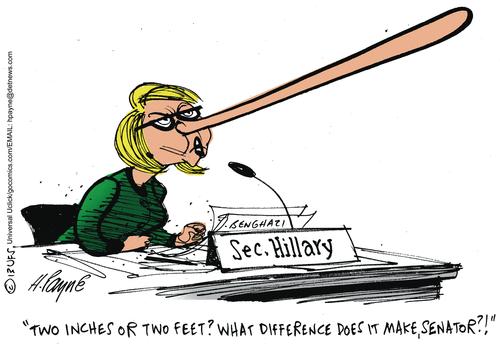
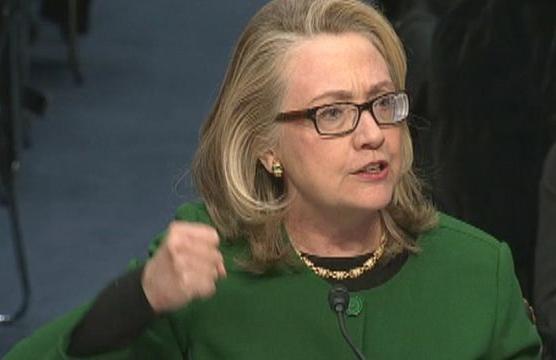
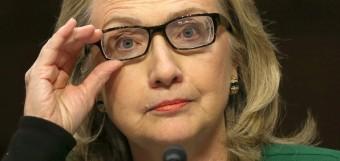
JERUSALEM – During the Senate hearing on
Benghazi yesterday, outgoing Secretary of State Hillary Clinton
claimed she did not know whether the U.S. special mission
attacked on Sept. 11 was involved in gun-running.
The remarks were perhaps the most important and telling of the
entire hearing since they address a possible motive behind the
jihadist attacks.
Yet Clinton’s answers were largely unreported by U.S. news
media.
The exchange on the subject took place with Sen. Rand Paul, R-Ky.
Paul asked Clinton: “Is the U. S. involved with any
procuring of weapons, transfer of weapons, buying, selling,
anyhow transferring weapons to Turkey out of Libya?
“To Turkey?” Clinton asked. “I will have to take
that question for the record. Nobody has ever raised that with
me.”
Continued Paul: “It’s been in news reports that ships
have been leaving from Libya and that may have weapons, and what
I’d like to know is the annex that was close by, were they
involved with procuring, buying, selling, obtaining weapons, and
were any of these weapons being transferred to other countries,
any countries, Turkey included?”
Clinton replied, “Well, senator, you’ll have to direct
that question to the agency that ran the annex. I will see what
information is available.”
“You’re saying you don’t know?” asked Paul.
“I do not know,” Clinton said. “I don’t have
any information on that.”
That section of the exchange with Paul was almost entirely
ignored by media, which instead focused on the Republican
senator’s earlier statement that if he were president he
would have relieved Clinton of her post.
WND has filed numerous reports quoting Middle East security
officials who describe the mission in Benghazi as a meeting place
to coordinate aid for the rebel-led insurgencies in the Middle
East.
In September, WND also broke the story that the slain U.S.
ambassador, Christopher Stevens, played a central role in
recruiting jihadists to fight Bashar al-Assad’s regime in
Syria, according to Egyptian security officials.
In November, Middle Eastern security sources further described
both the U.S. mission and nearby CIA annex in Benghazi as the
main intelligence and planning center for U.S. aid to the rebels
that was being coordinated with Turkey, Saudi Arabia and Qatar.
Many rebel fighters are openly members of terrorist
organizations, including al-Qaida.
Among the tasks performed inside the building was collaborating
with countries, most notably Turkey, on the recruitment of
fighters – including jihadists – to target Assad’s
regime, the security officials said.
According to the 39-page report released last month by
independent investigators probing the attacks at the diplomatic
facility, the U.S. mission in Benghazi was set up without the
knowledge of the new Libyan government, as WND reported.
“Another key driver behind the weak security platform in
Benghazi was the decision to treat Benghazi as a temporary,
residential facility, not officially notified to the host
government, even though it was also a full-time office
facility,” the report states. “This resulted in the
Special Mission compound being excepted from office facility
standards and accountability under the Secure Embassy
Construction and Counterterrorism Act of 1999 (SECCA) and the
Overseas Security Policy Board (OSPB).”
The report, based on a probe led by former U.S. diplomat Thomas
Pickering, calls the facility a “Special U.S. Mission.”
During the Libyan revolution against Moammar Gadhafi’s
regime, the U.S. admitted to directly arming the rebel groups.
At the time, rebel leader Abdel-Hakim al-Hasidi acknowledged in
an interview that a significant number of the Libyan rebels were
al-Qaida fighters, many of whom had fought U.S. troops in Iraq
and Afghanistan.
He insisted his fighters “are patriots and good Muslims, not
terrorists,” but he added that the “members of al-Qaida
are also good Muslims and are fighting against the invader.”
Media cover up?
From the beginning, U.S. media reports on the events in Benghazi
have been misleading.
The vast majority of media coverage worldwide refers to the U.S.
facility that was attacked as a “consulate,” even
though the government itself has been careful to call it a
“mission.”
A consulate typically refers to the building that houses a
consul, who is the official representative of the government of
one state in the territory of another. The U.S. consul in Libya,
Jenny Cordell, works out of the embassy in Tripoli.
Consulates at times function as junior embassies, providing
services related to visas, passports and citizen information.
On Aug. 26, about two weeks before his was killed, Ambassador
Stevens attended a ceremony marking the opening of consular
services at the Tripoli embassy.
The main role of a consulate is to foster trade with the host and
care for its own citizens who are traveling or living in the host
nation.
Diplomatic missions, on the other hand, maintain a more
generalized role. A diplomatic mission is simply a group of
people from one state or an international inter-governmental
organization present in another state to represent matters of the
sending state or organization in the receiving state.
However, according to the State Department investigation, the
building was a “U.S. Special Mission” set up without
the knowledge of the Libyan government.
Withholding, misleading
Two days before the November presidential election, CBS posted
additional portions of a Sept. 12 “60 Minutes”
interview in which Obama made statements that contradicted his
earlier claims about the attack.
In the released portions of the interview, Obama would not say
whether he thought the attack was terrorism. Yet he would later
emphasize at a presidential debate that in the Rose Garden on the
day of the attack, he had declared it an act of terror.
Reuters was also implicated by WND for possibly false reporting.
In the immediate aftermath of the attack, Reuters quoted a
purported civilian protester by his first name who described a
supposedly popular demonstration against an anti-Muhammad film
outside the U.S. building.
Immediately following the attack, President Obama and other White
House officials claimed anti-American sentiment fueled by the
obscure anti-Muhammad video on YouTube sparked civilian protests
outside the U.S. mission that devolved into a jihadist onslaught.
However, vivid accounts provided by the State Department and
intelligence officials later made clear no such popular
demonstration took place. Instead, video footage from Benghazi
reportedly shows an organized group of armed men attacking the
compound, officials said.
With research by Joshua Klein